
- New
- We recommend
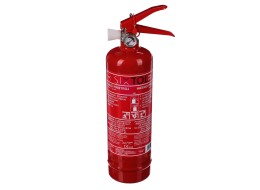
Powder fire extinguisher FIRE STOP 1 kg, ABC, all-metal, including metal bracket
Out of stock
14,80 Eur
DetailAre you planning to go abroad by car, van or truck? Mandatory equipment varies from country to country in Europe. While in some countries a fire extinguisher is not mandatory in a passenger car, in others you must have one during a roadside check. For example, in Spain a missing fire extinguisher in vehicles subject to the requirement can mean a fine of up to 200 euros.
There are no uniform rules in the EU
Many drivers assume that mandatory car equipment is similar throughout the European Union. In reality it is not that simple. The EU does not have a unified regulation that sets the same mandatory equipment for all member states. Each country can set its own rules for items such as high-visibility vests, warning triangles, winter tires or fire extinguishers.
This means that if you travel abroad you should not rely only on the Czech mandatory equipment. When passing through multiple countries it pays to verify the rules for each country you will pass through.
Spain: fire extinguisher for buses and trucks over 3.5 t
Spain is a good example of a country where rules differ by vehicle type. According to the official Your Europe overview, in Spain buses and trucks over 3.5 tonnes must have a fire extinguisher in addition to the usual equipment.
Therefore a fire extinguisher is not generally mandatory for an ordinary passenger car in Spain. A different situation arises for vehicles towing a trailer or caravan, or for vehicles falling into categories where a fire extinguisher is required.
The Spanish newspaper El País states that for vehicles subject to this obligation a missing fire extinguisher can carry a fine of up to 200 euros.
For carriers, van drivers with trailers or operators of trucks it is therefore better to have a fire extinguisher in the vehicle and not risk the fine.
Where is a fire extinguisher mandatory in a car?
The obligation to have a fire extinguisher in a car most often appears in countries of Central, Eastern and Southern Europe. For ordinary passenger vehicles a fire extinguisher is listed as mandatory equipment in, for example, the following countries:
For example, in Poland a fire extinguisher is listed among the vehicle’s safety equipment together with a warning triangle.
For trucks, buses, vehicles over 3.5 tonnes or vehicles with a trailer the rules can be even stricter. A typical example is Spain, where the obligation explicitly applies to buses and trucks over 3.5 tonnes.
Why is a fire extinguisher useful even where it’s not mandatory?
A fire extinguisher is not just an item on the mandatory equipment list. In the event of a fire in the engine compartment, ignition of wiring or after an accident it can help prevent greater damage. For company vehicles, vans, trucks or motorhomes it makes sense to carry one year-round even if a particular country does not explicitly require it.
A small powder extinguisher does not take up much space in the vehicle, but during a check abroad it can save you trouble and in an emergency prevent significant damage.
What to look for when choosing a fire extinguisher for a car?
A fire extinguisher should not lie loose in the trunk where it can move during sudden braking. A firm mount in a bracket is ideal.
Summary: it pays to have a fire extinguisher in the car
Before traveling abroad always check the current mandatory equipment in the countries you will pass through. In some EU countries a fire extinguisher is already mandatory for ordinary passenger cars, in others the obligation mainly concerns trucks, buses, trailers or caravans.
In Spain a missing fire extinguisher for vehicles subject to the requirement can be associated with a fine of up to 200 euros. Therefore the simple recommendation is clear: if you travel around Europe, it’s better to keep a fire extinguisher in the vehicle at all times.
SIXTOL Tip
In the SIXTOL range you will find practical car equipment and accessories that help prepare your vehicle for trips at home and abroad.