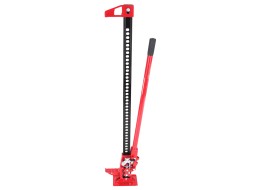
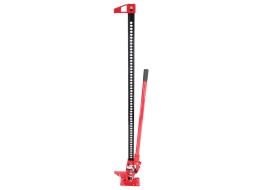
Universal lever jack SX FARM JACK L 3T, 130-1320mm
In stock
86,90 Eur
DetailFARM JACK (often known as the 'Hi-Lift' jack) is a versatile lever-operated mechanical jack used not only for lifting but also for recovery, tensioning, pulling and various assembly tasks. SIXTOL offers two variants of lever jacks SX FARM JACK with a 3T capacity – in this article you’ll find a brief overview of the models, practical tips on when to choose which model and how to work with them safely.
SIXTOL SX FARM JACK M 3T, 130–1045 mm
SIXTOL SX FARM JACK L 3T, 130–1320 mm
Accessory tip: For work on soft ground (sand, mud, gravel) a stabilizing base plate for the lever jack MECHANIC BASE 1 (SX3066) is useful – it improves stability and reduces the risk of the jack sinking into the surface. The SX3066 pad is not included with the SX FARM JACKs.
Both versions have a 3T capacity – the main difference is the stroke. If you lift taller vehicles or need extra lift reserve (e.g. in off-road, with vans or tractors), choose SX3087. For general use and easier carrying, SX3086 is often sufficient.
Common scenarios where a FARM JACK is useful:
A FARM JACK needs a solid point for the lifting foot to 'bite' into (e.g. frame, bull bar, dedicated lifting points, rock slider etc.). On ordinary passenger cars without modifications there often isn’t a safe point for a FARM JACK – in those cases a classic hydraulic jack is usually the better choice.
Work on as level and firm a surface as possible. Apply the parking brake, engage a gear/park mode and use wheel chocks. Securing the vehicle is key so the lifted object cannot move unexpectedly.
The base must sit firmly without wobbling. On soft ground use the stabilizing base plate SX3066 – it improves stability and reduces the risk of the base sinking in.
The jack’s foot must be supported on a solid point and the jack must stand vertically. FARM JACKs have a long stroke – if it starts to tilt, stop work and realign everything.
Lift smoothly in steps. Once you reach the required height, always support the vehicle or load (stands, blocks, stable supports). A FARM JACK is a lifting device – it is not intended as long-term support.
When lowering, keep the handle firmly under control. With lever jacks the handle can suddenly 'kick' when released (rebound). Always keep your head and body out of the handle’s path and lower in steps.
Besides lifting, lever jacks are used for:
Note: When using as a 'winch'/towing tool always think about safety: use appropriate chain/strap, protect against snapping and never stand in the line of pull.
A FARM JACK is mechanical – it benefits from regular cleaning and lubrication. After work in mud or dust clean it, check the mechanism and occasionally lightly lubricate moving parts. Store it so it is not exposed for long periods to moisture and aggressive contaminants.
Want a versatile farm jack for off-road, farm and general terrain use? Choose SX3086. If you need an extra-long stroke and more lift reserve, go for SX3087. And if you often work in rough terrain, add the SX3066 pad – it will significantly increase confidence and safety.