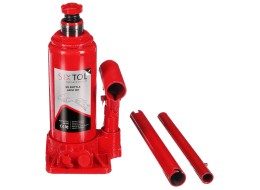
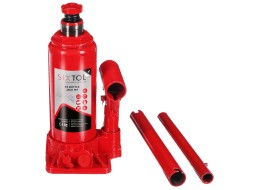
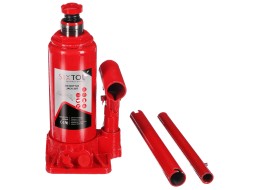
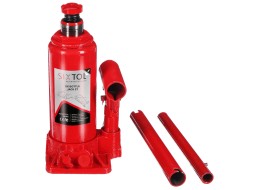
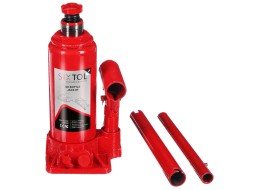
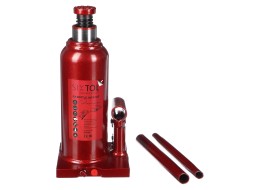
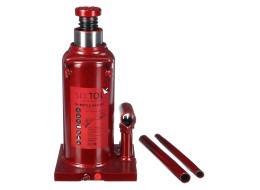
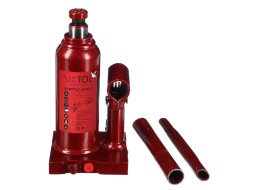
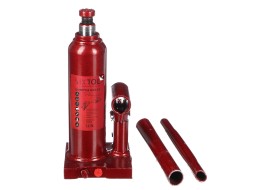
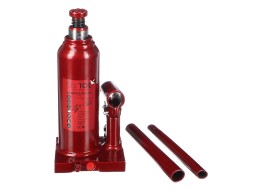
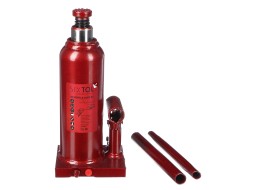
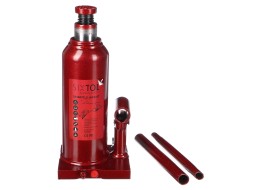
What is the difference between the standard bottle jack and the PREMIUM version?
Comparison of SIXTOL ranges: SX BOTTLE JACK vs SX BOTTLE JACK PREMIUM (order codes in the article)
1) What a bottle jack is and what it is used for
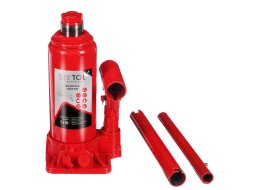
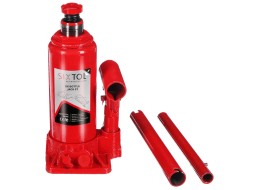
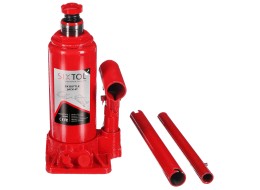
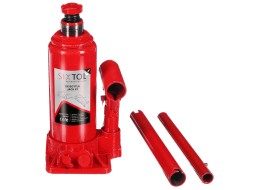
A bottle jack (hydraulic jack) is a compact lifting device intended for short-term lifting of a vehicle or a load – typically for tire changes, service work, or handling a trailer. Compared to trolley jacks it is smaller, easy to carry and often fits in the car trunk.
Safety first
The jack is only for lifting – after lifting always secure the vehicle with safety stands (jack stands).
Work on a level, solid surface and secure the vehicle (handbrake, wheel chocks).
Do not exceed the rated capacity and always lift at designated lifting points of the vehicle.
After a long period of non-use it is advisable to "work" the jack a few full strokes without load so the oil distributes properly.
2) Main differences: Standard vs PREMIUM
SX BOTTLE JACK (standard range)
A practical choice for the home garage, occasional tire changes and emergency use on the road.
Compact construction and simple operation – suitable for regular users.
Most variants have an adjusting screw at the top for fine height adjustment (exception is model 32T – SX3075).
SX BOTTLE JACK PREMIUM (premium range)
Designed for maximum reliability and safety during frequent use (workshop, tire service, mobile service).
Fully welded construction without joints – higher durability, lower risk of oil leakage and longer service life.
Suitable for harsher conditions and for users who want more "worry-free" operation.
Most variants have an adjusting screw at the top for more precise height setting.
3) How to choose the correct capacity (tonnes)
The most common mistake when choosing is underestimating the margin. A jack usually lifts only one part of the vehicle (e.g. one axle), but the load can vary depending on weight distribution. Recommendations:
Start from the vehicle weight and add a margin of at least 30–50%.
For a typical passenger car 2T–3T is often sufficient; for SUVs and vans 4T–6T is usually more suitable.
For trailers, caravans and heavier equipment choose higher capacities (8T+), according to the real weight of the load.
Tip: If you use the jack frequently (e.g. in a workshop), it pays off to choose the PREMIUM version in the same capacity – you gain higher durability and longer service life.
4) Order codes (overview of ranges and capacities)
Standard range: SX BOTTLE JACK
Capacity
Order code
2 t
SX1144
3 t
SX1145
4 t
SX1146
6 t
SX1147
8 t
SX1148
10 t
SX1149
16 t
SX3073
20 t
SX3074
32 t
SX3075
Premium range: SX BOTTLE JACK PREMIUM
Capacity
Order code
2 t
SX3077
3 t
SX3078
4 t
SX3079
6 t
SX3080
8 t
SX3081
10 t
SX3082
16 t
SX3083
20 t
SX3084
32 t
SX3085
5) When to choose standard and when PREMIUM (quick recommendation)
Choose SX BOTTLE JACK (standard) if:
you use the jack only occasionally (seasonal tire changes, emergency wheel replacement),
you want the best price/performance ratio for home use,
you need a compact jack in the car as a backup.
Choose SX BOTTLE JACK PREMIUM if:
you use the jack frequently or daily (workshop, tire service, mobile service),
you want maximum reliability and long service life thanks to the fully welded construction,
you work in harsher conditions or lift heavier trailers/caravans and want more reserve.
6) Practical tips for use
Prepare jack stands and wheel chocks before lifting – safety is the priority.
Lift slowly and check that the jack is vertical and bears on a solid lifting point.
After use clean the jack, store it in a vertical position and regularly check for oil leaks.
7) Most common mistakes when lifting a vehicle
Lifting on a soft or inclined surface – the jack can tilt and the load can fall.
Supporting outside the vehicle's lifting point – risk of damage to sills or chassis.
Working under the vehicle without stands – the jack is not intended as a long-term support.
Overloading the jack or using it at the limit without capacity margin.
Rapid pumping without checking stability – always continuously check whether the load is moving.
8) Maintenance and storage
To keep the jack serving long and safely, give it basic care:
Keep the jack clean and dry. Wipe off dirt after use, especially from the piston rod.
Store in a vertical position (according to manufacturer recommendation) and protect from frost and moisture.
If the jack feels slow or "gives", stop work and check the condition – bleeding or service may be needed.
During long-term storage perform a few strokes without load occasionally.