
- New
- We recommend
Powder fire extinguisher FIRE STOP 1 kg, ABC, all-metal, including metal bracket
Out of stock
14,80 Eur
DetailA fire extinguisher in a car is one of those accessories most drivers only think about when they travel abroad, buy a motorhome, or carry more risky cargo. However, there is no single simple rule across Europe that would apply to all vehicles in all countries. Mandatory equipment varies by country, vehicle type, and intended use.
Therefore it pays to distinguish whether it concerns an ordinary passenger car, a van, a truck, a bus, a vehicle transporting dangerous goods under ADR, or a caravan and motorhome. In some countries a fire extinguisher is part of the mandatory equipment, elsewhere it is required only for selected vehicle categories, and in other states it is mainly a recommended safety item.
Important: always check the rules of the countries you will be traveling through before your trip. Requirements for company vehicles, passenger transport, commercial transport and freight may be stricter than for an ordinary passenger car.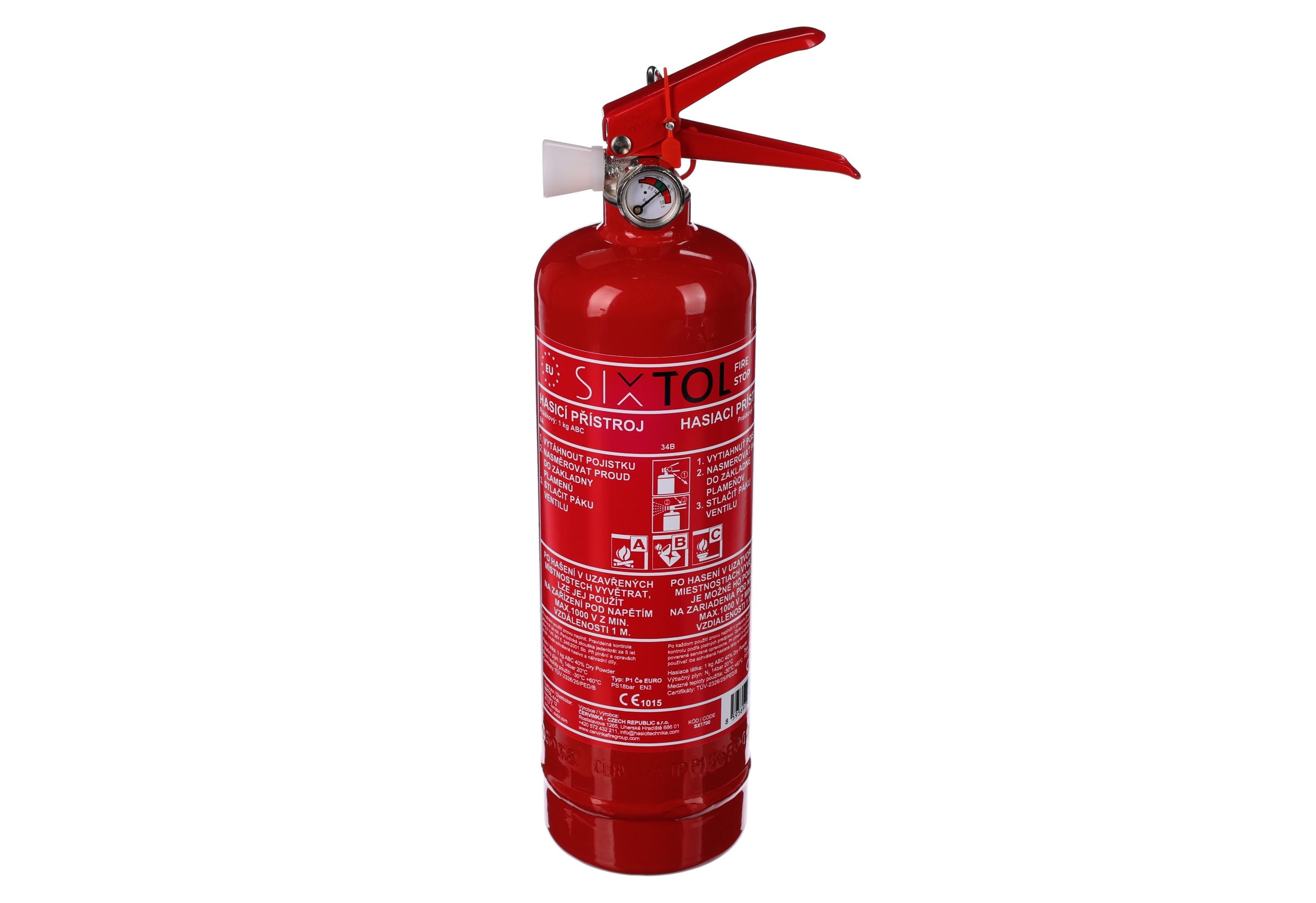
There is no unified obligation for the entire EU
Mandatory vehicle equipment is not fully harmonized within the European Union. This means one country may require a fire extinguisher in a passenger car, while another considers it only a recommendation. Differences concern not only fire extinguishers but also high-visibility vests, first-aid kits, warning triangles or spare bulbs.
From a practical perspective it is therefore best to treat a fire extinguisher as equipment useful across Europe. Even if it is not mandatory for an ordinary passenger vehicle in a given country, it can significantly help with an incipient fire in the engine bay, the interior, the trunk or around the vehicle.
Quick overview: passenger car, truck, bus, caravan
| Vehicle type | How it is in Europe | SIXTOL recommendation |
|---|---|---|
| Passenger vehicle | There is no unified obligation for the entire EU. In some countries a fire extinguisher may be required even for ordinary passenger cars, elsewhere it is only recommended. | When traveling around Europe carry a compact powder fire extinguisher, ideally easily accessible from the driver’s area or the trunk. |
| Van and light commercial vehicle | Rules vary by country and by purpose of use. There may be a difference between a private and a company vehicle or between a standard van and transporting hazardous cargo. | For company cars and vans we recommend a fire extinguisher as standard safety equipment. |
| Truck | For ordinary freight transport it depends on national regulations. For the transport of dangerous goods under ADR there are specific requirements for fire extinguishers. | For trucks do not underestimate the required capacity, inspection and placement of fire extinguishers. For ADR follow the applicable category and the vehicle’s weight. |
| Bus and passenger transport vehicle | In many countries vehicles for mass passenger transport are subject to stricter requirements than passenger cars. | The fire extinguisher should be easily accessible to the driver and crew, regularly checked and properly secured. |
| Caravan and motorhome | Obligation is assessed depending on the country, registration and vehicle type. In practice a motorhome combines a car, a kitchenette, electrical installation, gas and often camping equipment. | We recommend at least one fire extinguisher in every caravan and motorhome, ideally supplemented by a fire blanket in the kitchen area. |
Passenger vehicle: mandatory in some places, recommended in others
For ordinary passenger cars the biggest differences are between countries. Some European states require a fire extinguisher, others do not require it at all or only for specific vehicles, for example taxis, driving school cars, company cars or vehicles used for commercial transport.
For drivers traveling across Europe it is safest not to rely only on the minimum required by law. A compact fire extinguisher takes up little space in a car but, with a quick response, can help contain an incipient fire before it spreads to the entire vehicle.
Trucks and ADR: here it’s more than a recommendation
For trucks it is necessary to distinguish ordinary freight transport from transport of dangerous goods under the ADR agreement. ADR sets specific requirements for fire extinguishers depending on the nature of the transport and the weight of the transport unit.
In practice ADR requires fire extinguishers suitable for fire classes A, B and C. The minimum required capacity depends on the vehicle’s total weight and the type of transport. For small quantities it may be 2 kg of powder extinguishing agent, for heavier transport units the requirements increase to, for example, a total capacity of 8 kg or 12 kg. The fire extinguisher must be suitable for use in a vehicle, secured against unintended movement and regularly inspected.
For carriers it is important not to rely on general internet advice. For ADR transport you must follow the current wording of the regulations, driver training, internal documentation and specific transport requirements.
Caravan and motorhome: a fire extinguisher should be a matter of course
A caravan or motorhome is specific in that it combines transport, living, cooking, electrical installation, batteries, gas appliances, textiles and luggage in one space. The fire risk therefore may not only be related to the engine but also to cooking, charging, heating, electrical installation or careless handling at the campsite.
SIXTOL recommendation: every caravan and motorhome should have at least one fire extinguisher. It is ideal to place it so that it is quickly accessible when entering the living area or from the driver’s position. Additionally, a fire blanket in the kitchen area is useful, especially for small cooking fires.
When traveling with a motorhome across Europe we recommend checking not only the legislation of the destination country but also the rules of campsites, insurers and rental companies. For rented motorhomes safety equipment is often part of the handover protocol.
How many vehicle fires occur in Europe?
The exact pan-European number of vehicle fires is not easy to state because European countries do not always use the same data collection methodology. The EU FireStat project highlights that terminology, methodology and reporting need to be harmonized for European comparison of fires.
For an idea one can use national statistics. For example, fire and rescue services in England recorded a total of 18,424 road vehicle fires for the year ending June 2025. This is not an EU-wide figure but clearly shows vehicle fires are not negligible.
A separate European statistic reliably stating how many of these fires are specifically motorhomes and caravans is not commonly available in a unified form. Preventive equipment makes great sense for motorhomes, since a fire can start not only while driving but also while parked at a campsite or during cooking.
Which fire extinguisher to choose for a car?
Summary: when to carry a fire extinguisher?
If you travel around Europe, consider a fire extinguisher a practical part of your safety gear. For passenger cars it depends on the specific country. For trucks, commercial transport, buses and especially ADR transport the requirements can be significantly stricter. For caravans and motorhomes we recommend a fire extinguisher always, even if local law does not explicitly require it.
A properly chosen and well-placed fire extinguisher can determine whether damage remains minor or a small fault turns into a major fire. That is why it pays to have one in the vehicle before you actually need it.
SIXTOL Tip
When choosing equipment for your car think not only about the legal minimum but also about real situations on the road. For passenger cars, vans, caravans and motorhomes it’s worth selecting compact and easily accessible safety accessories that don’t take up much space and can help in an unexpected event.