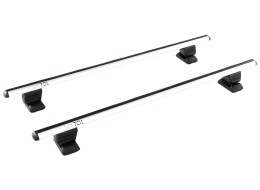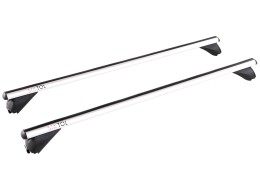
- We recommend
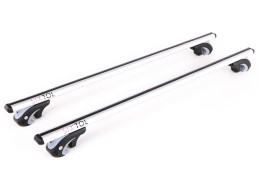
Aluminum crossbar with lock ROOF RACK 120 cm, load capacity 90 kg
In stock
54,20 Eur
DetailYou want to put a roof box, bikes or skis on the roof – but you’re not sure which attachment type your car has? Choosing SIXTOL crossbars is simple: the roof type decides – raised roof rails, integrated rails or fix points. In this article we’ll show you how to recognize it in one minute and which model to choose.
You can recognize classic raised rails because they are on 'legs' – there is a visible gap between the rail and the roof. Often you can easily slide your fingers under them.
Typical sign: a gap under the rail (the rail is not flush with the roof).
Use: roof box, bike carrier, skis, other T-slot accessories (T-bolt).
Right choice: SIXTOL ROOF RACK – code SX1016 (120 cm, max load 90 kg).
Integrated/flush rails sit directly on the roof – without a gap. They are typical for newer estates and SUVs. If the rail is 'joined' to the roof, this is the type.
Typical sign: no gap between the rail and the roof.
Important: measure the spacing where the feet will clamp (both front and rear positions).
According to customer queries the maximum spacing of the feet when set in the extreme position is approximately 115 cm.
Right choice: SIXTOL ROOF RACK IN 1 – code SX1018 (120 cm, max load 90 kg).
If the car has no roof rails it may have so-called fix points (pre-prepared mounting points in the roof). You can recognize them by the covers/plugs on the roof – after removing them you’ll find mounting holes (typically 4 points).
Typical sign: there are caps/plugs on the roof; under them are mounting holes for attachment.
For vans larger spacings are sometimes required – in some vehicles longer crossbars are used (e.g. 135 cm).
Right choice: SIXTOL ROOF RACK FIX 1 – code SX1019 (120 cm, max load 90 kg).
| Model | Attachment | Length | Max. load | T-slot | Lock |
|---|---|---|---|---|---|
| SX1016 | For raised longitudinal rails | 120 cm | 90 kg | 20 mm | Yes |
| SX1018 | For integrated/flush rails | 120 cm | 90 kg | 20 mm | Yes (2 keys) |
| SX1019 | For fix points | 120 cm | 90 kg | 20 mm | Yes (2 keys) |
"I have a new SUV and I don’t know if the rails are integrated."
Look for the gap: gap = classic raised rails (SX1016). No gap = integrated rails (SX1018).
"The same car model comes with different roof versions – what now?"
Don’t rely only on the model year. Check the roof and re-measure the spacing at the attachment points.
"How do I recognize fix points?"
Look for plugs/covers on the roof. After removing them you’ll see mounting holes (usually 4 points).
Not sure? Send us a photo of the roof from the side (and ideally the measured spacing at the front and rear positions) – we will quickly confirm compatibility.